
Posted At: 22-Apr-2026 - 1,570 Views
Introduction
India continues to face significant challenges in managing vector-borne diseases such as dengue and malaria. Despite continuous efforts through surveillance programs and healthcare infrastructure, outbreaks are often detected too late, resulting in increased patient load, strained healthcare systems, and preventable loss of life.
Traditional public health systems largely follow a reactive approach, where action is taken only after cases begin to rise. However, with the rapid advancement of technology, especially Artificial Intelligence (AI), there is a powerful opportunity to shift toward a predictive and preventive healthcare model.
At Max Vision Solutions, we specialize in building intelligent, scalable, and data-driven systems that empower organizations to make faster and smarter decisions. In this blog, we explore how AI-powered Early Warning Systems (EWS) can transform disease surveillance and help prevent outbreaks before they occur.
The Current Challenge: Reactive Healthcare Systems
Most existing disease surveillance systems depend on manual reporting and historical data analysis. While useful, these systems face several limitations:
- Delayed reporting from ground-level health workers
- Fragmented data across multiple departments
- Limited use of environmental and climate data
- Lack of predictive capabilities
Diseases like dengue and malaria are highly influenced by environmental conditions such as rainfall, temperature, and humidity. Without integrating such data into predictive systems, it becomes difficult to anticipate outbreaks.
As a result, health authorities often respond when it is already too late.
What is an Early Warning System (EWS)?
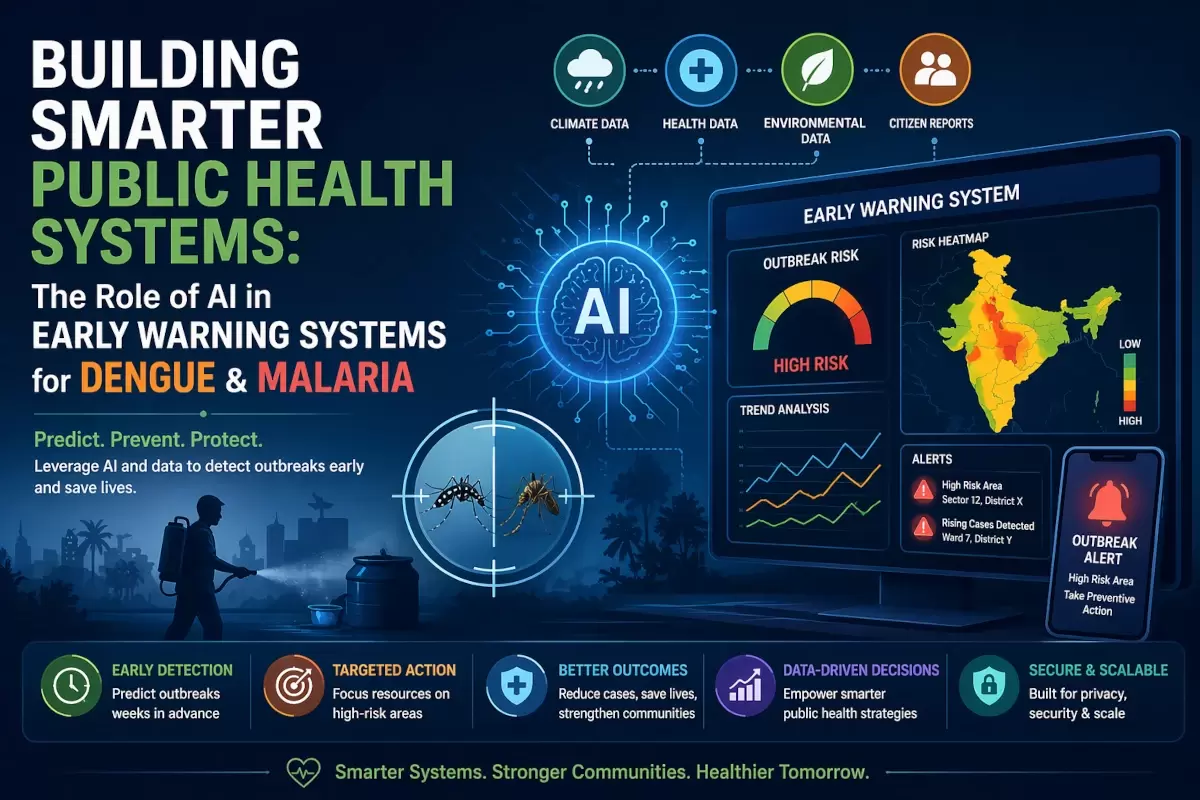
An Early Warning System is a digital platform designed to detect potential disease outbreaks before they escalate. It combines multiple data sources with advanced analytics to provide early alerts and actionable insights.
A modern EWS typically includes:
- Data Integration: Health, climate, and environmental data
- AI/ML Models: Predict outbreak risks using historical and real-time data
- Dashboards: Visual insights through heatmaps and trends
- Alert Systems: Notifications via SMS, email, and mobile apps
The primary goal of an EWS is to predict, prevent, and protect.
Why AI is Transforming Disease Prediction
Artificial Intelligence brings speed, accuracy, and adaptability to public health systems.
Predictive Capabilities:
AI analyzes large datasets to identify patterns and forecast outbreaks before they occur.
Real-Time Insights
With continuous data flow, authorities can monitor situations in real time and act quickly.
Continuous Learning
Machine learning models improve over time, making predictions more accurate with each cycle.
Risk Mapping
AI generates region-wise risk scores and heatmaps, enabling targeted interventions.
Key Components of an AI-Based EWS Platform
A robust Early Warning System is built on multiple interconnected components:
1. Data Integration Layer
Collects data from health systems (IDSP, HMIS), weather APIs, environmental sources, and citizen inputs.
2. Data Processing Layer
Cleans, validates, and transforms raw data into structured formats for analysis.
3. AI/ML Analytics Layer
Applies predictive models, risk scoring, and forecasting algorithms.
4. Application Layer
Includes dashboards for authorities, mobile apps for field workers, and alert systems.
5. Security & Governance Layer
Ensures data privacy, access control, and compliance with standards.
System Architecture Overview
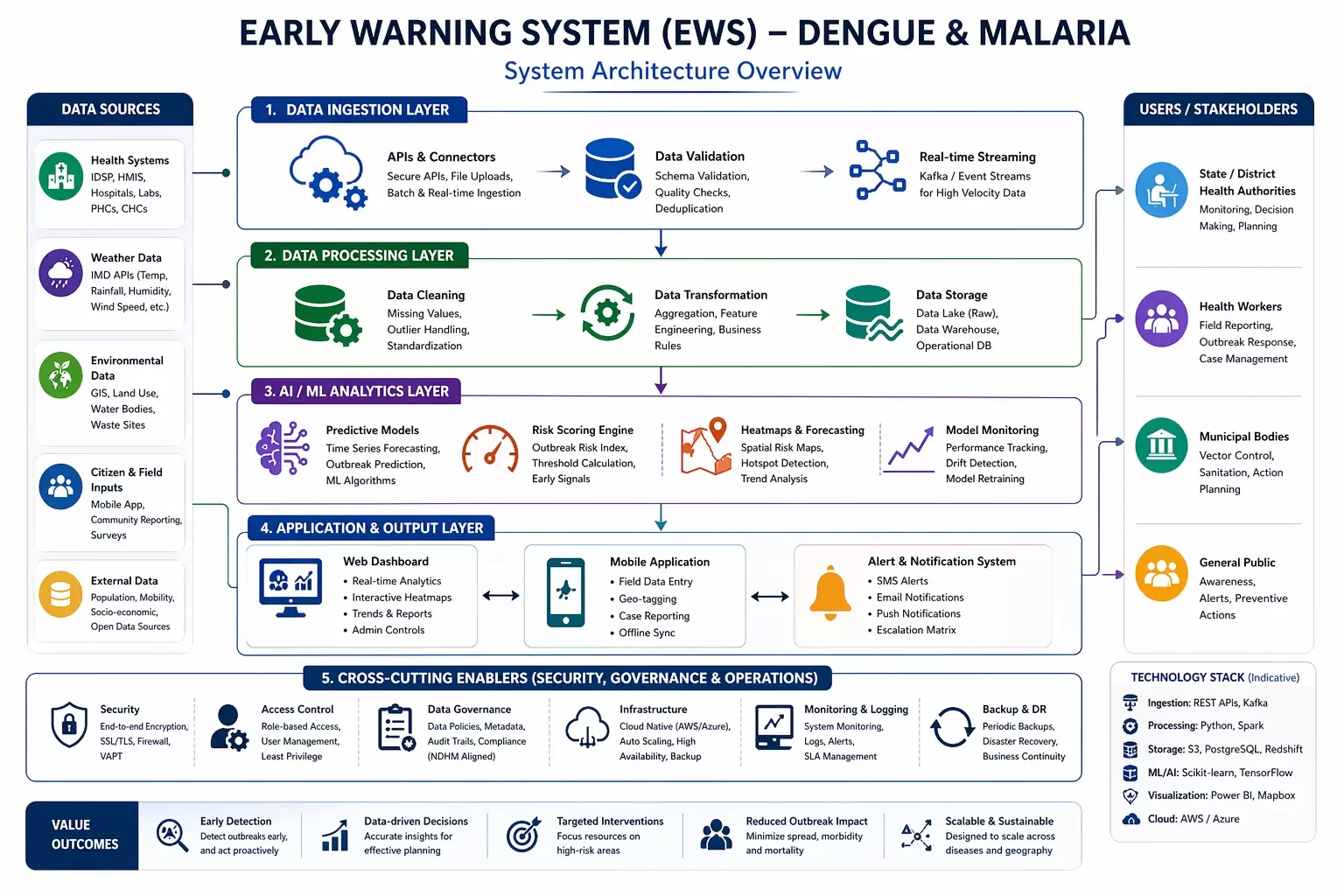
A modern Early Warning System is designed using a scalable, cloud-native architecture that enables seamless integration of multi-source data and real-time analytics.
At the foundation, the system ingests data from multiple sources such as healthcare systems, weather platforms, environmental datasets, and citizen-reported inputs. This data is processed through secure pipelines, validated, and transformed into structured formats.
The AI/ML layer plays a critical role by applying predictive models to generate outbreak forecasts, risk scores, and heatmaps. These insights are then delivered through user-friendly interfaces such as web dashboards and mobile applications, along with automated alert systems including SMS and email notifications.
The architecture also incorporates strong security, governance, and interoperability features, ensuring high availability, data protection, and seamless integration with government health systems.
Real-World Impact of Early Warning Systems
Implementing an AI-powered EWS can significantly improve public health outcomes:
Early Detection
Outbreaks can be predicted weeks in advance, allowing proactive action.
Targeted Interventions
Authorities can focus resources on high-risk areas instead of broad, inefficient measures.
Reduced Healthcare Burden
Preventing outbreaks reduces hospital admissions and pressure on healthcare systems.
Better Policy Decisions
Data-driven insights help governments design more effective long-term strategies.
Challenges in Implementing EWS (and Solutions)
1. Data Silos
Different departments operate independently.
Solution: Use interoperable APIs and unified data platforms.
2. Data Quality Issues
Incomplete or inconsistent data affects predictions.
Solution: Implement validation and cleaning mechanisms.
3. User Adoption
Field workers may resist new technology.
Solution: Provide training and simple user interfaces.
4. Infrastructure Constraints
Rural areas may lack connectivity.
Solution: Build offline-enabled mobile applications.
How Max Vision Solutions is Driving Innovation
At Max Vision Solutions, we focus on building next-generation digital solutions for healthcare and public sector organizations.
Our Expertise Includes:
- Custom healthcare software development
- AI/ML model development
- Data integration and analytics platforms
- Web and mobile application development
- Cloud-based scalable infrastructure
We design solutions that are not only technically advanced but also practical, user-friendly, and aligned with real-world needs.
The Future of Public Health: Predictive & Preventive
The future of healthcare lies in predictive intelligence and proactive action. With increasing environmental risks and population density, the need for advanced surveillance systems is more critical than ever.
AI-powered Early Warning Systems enable:
- Faster response times
- Better resource allocation
- Improved outbreak control
- Enhanced public safety
Governments and organizations that adopt these systems today will be better prepared for tomorrow.
Conclusion
Dengue and malaria continue to challenge public health systems, but technology offers a powerful solution. By integrating AI, data, and digital platforms, we can transform how outbreaks are detected and managed.
Early Warning Systems are not just technological tools—they are lifesaving innovations that can protect communities and strengthen healthcare systems.
At Max Vision Solutions, we are committed to building intelligent solutions that drive real-world impact and help create a healthier future.
Ready to Build Smarter Healthcare Systems?
If you are a government agency, NGO, or healthcare organization looking to implement AI-driven healthcare solutions: